Leading Institutes with Love
Malati Kalmadi, Secretary, Kannada Sangha, Pune, India
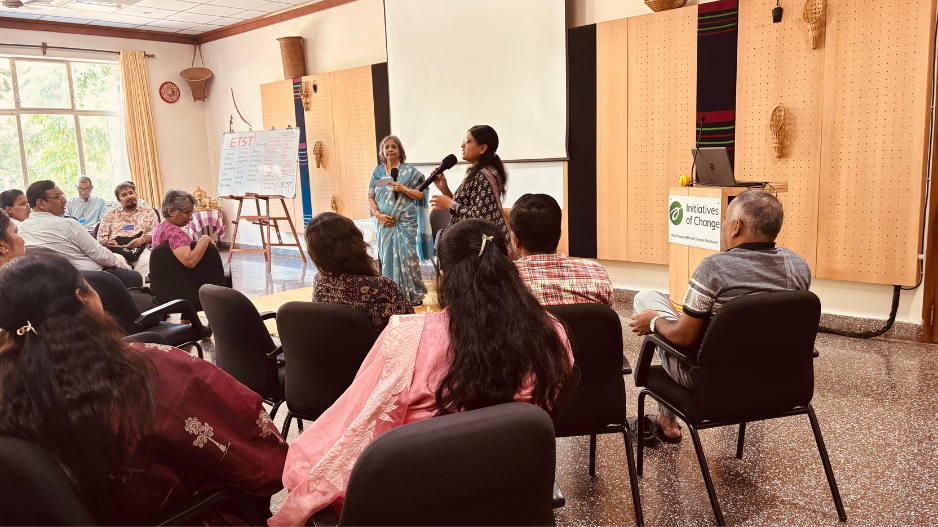
Education Today Society Tomorrow (ETST) India session
I come from the area of managing institutions. For over five decades, I have been part of an organisation that runs schools and a college in Pune—the Kaveri Group of Institutes. Our focus has always been the well-being of students, teachers, and parents. I believed I was doing meaningful work—and I was. Yet ETST helped me realise that good work becomes transformative only when it is rooted in inner alignment.
Almost a decade ago, I attended an ETST round table of school leaders. I stayed only briefly, and a few colleagues joined for a short time. But what I encountered there stayed with me. The conversations were serious, honest, and deeply concerned with the future of education and society. That recognition led me to my first ETST residential workshop at Asia Plateau, Panchgani. Like many of us, that retreat opened a door—not outside, but within.
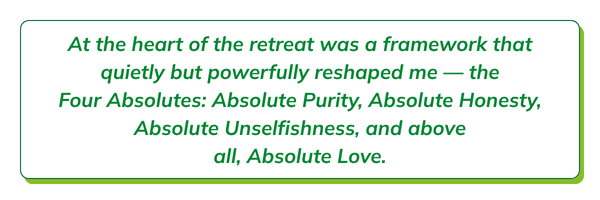
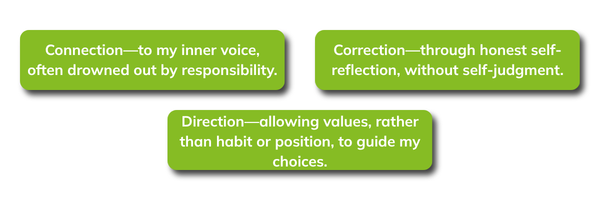
These were not taught as moral standards, but offered through PHUL—a flower, and a mirror. PHUL became a way of measuring where I stood personally, and gently pointing out what needed correction. It helped me move through three essential steps: Connection, Correction, and Direction.
Many sessions touched me deeply— Life’s Balance Sheet, the Circle of Concern and the Circle of Influence, India I Care, the Grampari visit, and the Multi-Faith Prayer. But equally powerful were the simple practices: sitting in silence in the early mornings, listening to real-life stories of struggle and courage, sharing in family groups, cleaning and washing together after meals, and sharing space with strangers. These experiences dissolved hierarchies and created genuine community.
Asia Plateau itself, built through courage and commitment, held us gently through this process. And I realised something important—I belonged here. I was among people who believed that if we want a peaceful world, we must first look honestly at ourselves.
Over time, I found myself drawn into the ETST core team—not by design, but by alignment. And slowly, the workshop did not remain at Panchgani; it travelled back with me into my institutions.
Quiet Time, Multi-Faith Prayer, India I Care – Coin for the Country, and Gram Setu—our urban– rural connect—found expression in the Kaveri Group of Institutes. ETST values began to live in everyday practice.
Among the Four Absolutes, Absolute Love became central to my life. I consciously practice it—in how I listen, how I lead, and how I respond. And I witness what I can only call small miracles. Relationships soften. Resistance melts. Decisions bring joy rather than burden. This practice has given me immense personal and professional fulfillment. ETST helped me understand the true meaning of Dharma.
ETST did not change my role. It changed my way of being. It taught me that:
Leadership begins with listening, that community grows through shared responsibility, and that lasting change begins within.